Chinese automakers surpass Japanese in dozens of global markets
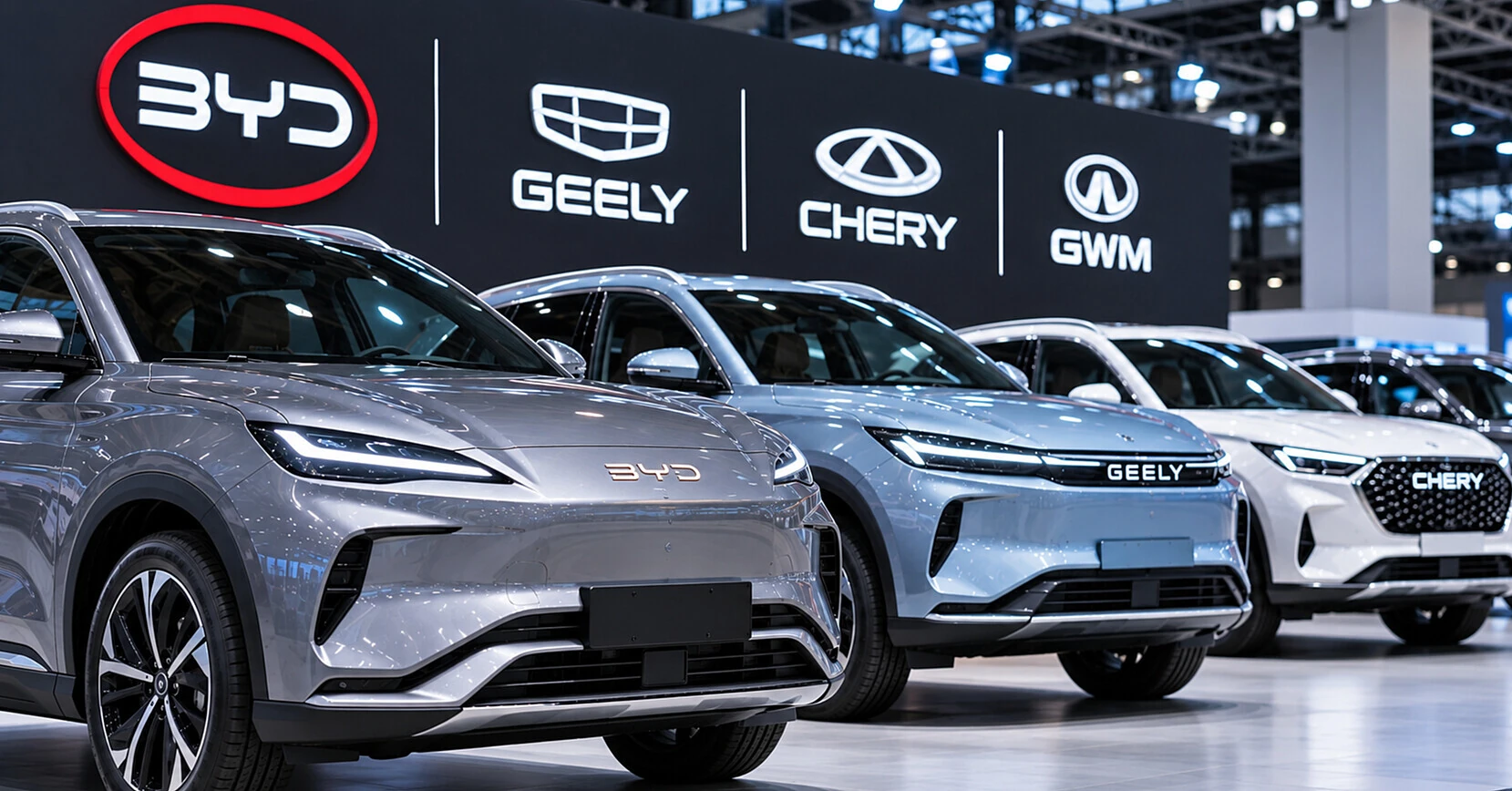
Chinese automotive companies continue to expand their presence in the global market and already outperform Japanese competitors in new car sales share in 39 countries. In the first nine months of 2026, Chinese brands took the lead in another 14 markets, including the largest European economies.
This was reported by Nikkei Asia, citing a study by American analytical company Mobility Global.
Experts analyzed new car sales for January–September 2026. The study covered 93 countries and territories for which comparable sales data by individual manufacturers is available.
In 39 of these countries, the combined share of Chinese automotive brands was higher than that of Japanese ones. Moreover, Chinese companies gained an advantage in 14 markets specifically in 2026.
Eight such markets are in Europe: Germany, Italy, Spain, the Netherlands, Belgium, Austria, Portugal, and Slovenia. Chinese manufacturers also surpassed Japanese ones in Brazil, South Korea, the United Arab Emirates, Kuwait, Iraq, and Tunisia.
Chinese cars strengthen positions in Europe
Particularly noticeable changes occurred in Germany, the largest automotive market in Europe.
Over nine months, the share of Chinese brands in Germany increased by 2 percentage points, reaching 6%. At the same time, the share of Japanese manufacturers decreased by 1 percentage point to 5%.
In Italy, Chinese automotive companies increased their share by 6 percentage points to 12%.
One of the main growth factors was sales of electric vehicles by Chinese company Leapmotor. From January to September, sales of this brand's cars in Italy increased approximately 11 times compared to the same period last year.
Significant changes are also observed in Brazil. Here, the share of Chinese manufacturers grew by 10 percentage points, reaching 19% of the new car market.
The expansion of Chinese brands is facilitated by the development of local production. In particular, BYD began producing cars at its own plant in Brazil in 2025.
In total, in the first nine months of 2026, overseas sales of Chinese automakers grew by 51% year-over-year, reaching 4.34 million vehicles.
Analysts attribute this dynamic primarily to increased demand for electric vehicles amid high global oil prices. Chinese companies actively offer electric and hybrid models, expanding dealer networks and localizing production in overseas markets.
Japanese manufacturers lose ground in Asia
Chinese brands are also intensifying competition in Southeast Asia, where Japanese companies have traditionally held a dominant position.
According to the study, in January–September, the combined share of Japanese manufacturers in the region decreased by 6 percentage points to 54%.
Meanwhile, Chinese companies increased their presence by 7 percentage points to 18% of the market.
The shift is especially noticeable in Thailand. The share of Japanese cars there fell by 8 percentage points to 56%, while Chinese cars rose by 11 points to 32%.
Thus, the gap between manufacturers from the two countries narrowed by almost 20 percentage points over the year.
In Indonesia, the difference between the shares of Chinese and Japanese brands shrank by 16 percentage points, and in the Philippines by 7 points.
Despite the intensifying competition, Japanese automakers continue to outperform Chinese brands in 54 of the 93 countries studied.
In particular, Japanese companies maintain strong positions in the United States and India. In the American market, their share reached 32%, up 1 percentage point due to sustained demand for hybrid vehicles.
In India, Japanese manufacturers hold about 44% of the market.
Both markets remain challenging for the expansion of Chinese automotive companies due to trade, regulatory, and other restrictions.
Competition creates risks for Japanese auto industry
According to Nikkei, the decline in Japanese manufacturers' share in overseas markets could affect not only vehicle sales but also the financial results of the entire industry.
Reduced sales volumes lead to lower factory utilization, increase unit production costs, and limit profits from related services, including auto financing, leasing, and spare parts sales.
If the trend continues, consequences may affect companies producing automotive components and materials, as well as other participants in production chains.
The study does not mean that China has already overtaken Japan in vehicle sales in all countries worldwide. It compares the combined market shares of Chinese and Japanese brands in individual countries where necessary statistical data is available.
Based on materials from: Nikkei Asia, The Korea Herald, Mind.ua.