U.S. tests drone that autonomously tracks a person without GPS
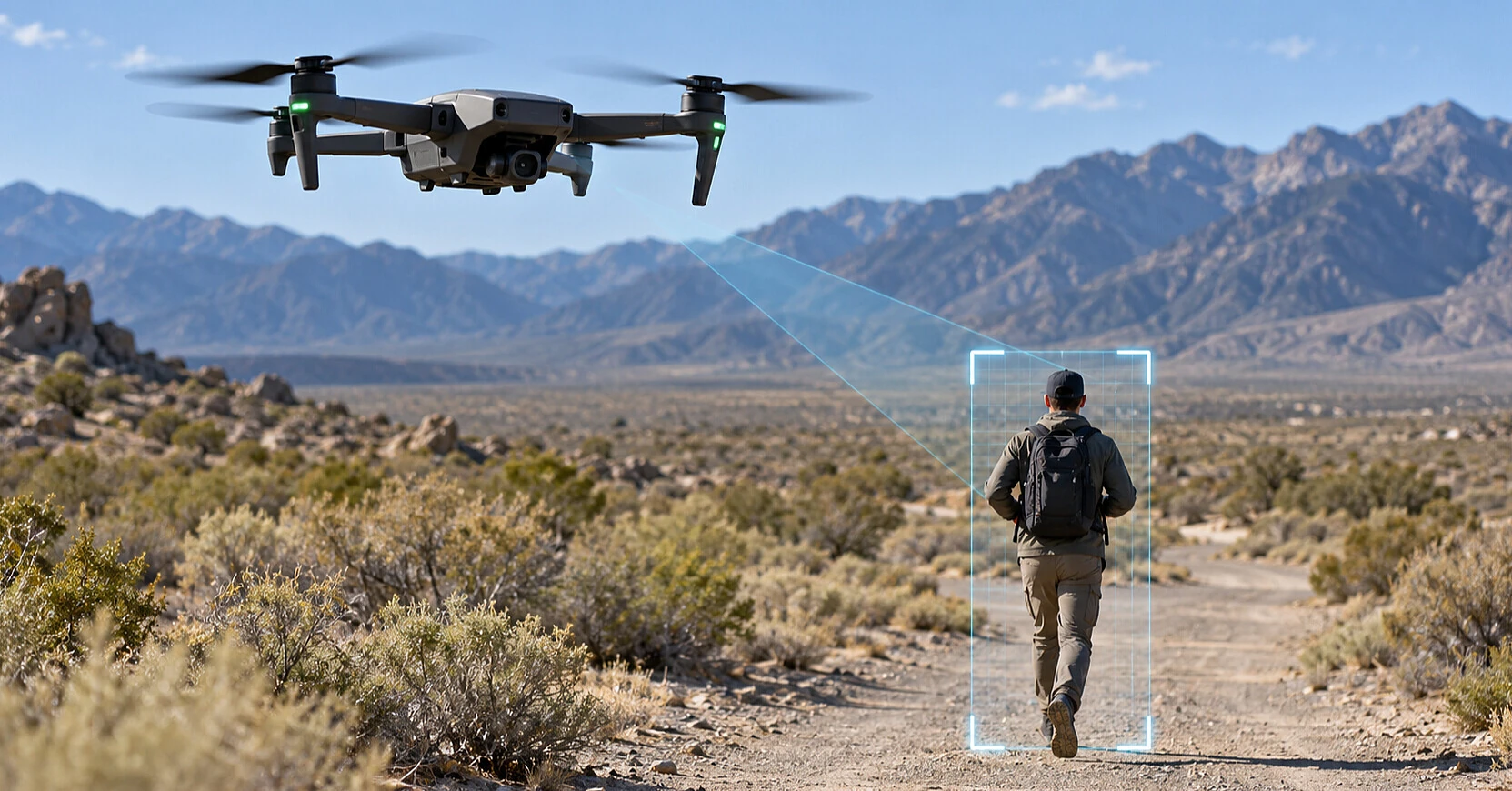
American researchers have demonstrated an autonomous drone capable of tracking a person in a dense forest without satellite navigation and constant operator control. The device independently orients itself between trees, avoids obstacles, and continues to follow the person even when they temporarily disappear from the camera's view.
The test results were released by Aniket Bera, a professor at Purdue University who leads the IDEAS Lab research laboratory. The technology details were also analyzed by the specialized publication DroneXL.
In the published video, the drone moves behind a person in a forested area, maintaining the required distance and changing its trajectory to avoid trees. Simultaneously, the system displays the positions of objects around the device and flight parameters.
The main feature of the development is the ability of autonomous navigation without GPS and cloud computing. According to Bera, the necessary calculations are performed directly on the onboard hardware.
To determine its position, the drone uses sensor data and a spatial mapping system. This allows it to assess the surrounding environment and plan further movement without a pre-loaded map of the area.
A separate algorithm is responsible for predicting the movement of the person. If they end up behind a tree or other obstacle, the system estimates the possible direction of their movement in order to resume tracking.
According to DroneXL's analysis, during the demonstration the device reached speeds up to about 11 km/h and flew at a low altitude. Such characteristics correspond to the experimental mode of accompanying a person, rather than testing an attack drone.
At the same time, the technology uses individual software solutions that were previously developed by other research teams. In particular, in the video one can see the designations SUPER and FAST-LIO - navigation and motion estimation systems associated with the MaRS Laboratory of the University of Hong Kong.
Bera later clarified that the team used open-source tools, while their own algorithms for motion planning and environment recognition are still undergoing scientific review.
After the video spread on social media, reports appeared that the system was allegedly created with the help of Claude Opus 5.5 from the company Anthropic. However, the original source of the demonstration does not confirm the use of this model. Also, no evidence has been presented that Claude directly runs on board the drone.
Anthropic has previously conducted its own research on autonomous drone control. In particular, in July, the company presented Project Pilot - an experiment using artificial intelligence models to search for and track a person with a drone indoors. However, this project is not confirmation of Anthropic's participation in the Purdue University test.
Such systems can be used for search and rescue operations, area monitoring, and work in conditions where satellite communication is unavailable. At the same time, autonomous tracking of people creates risks of using such technologies for military purposes or illegal surveillance.
At present, the researchers have demonstrated an experimental prototype. Independently confirmed data on its reliability in long flights or use in combat conditions is not available.
Based on: Aniket Bera, Purdue University, DroneXL, October 26, 2026, Anthropic, Project Pilot